GAME DESIGN DOC 2.0
Game: Darkspy (working title)
STUDIO: ECHELON INTERACTIVE
Game: Darkspy (working title)
STUDIO: ECHELON INTERACTIVE

Now, let’s “zoom out” and look at the gameplay loop from further back. The player isn’t just wandering through random rooms, facing encounter after encounter with no purpose after all. This gameplay loop covers the mission preparation and execution.
Darkspy has 15 maps.
They are a collection of interesting locations ranging from a prototype nuclear submarine, an AI weapons lab, an industrial-scale fentanyl factory , a cryogenic vault, a secret underground prison, a superyacht, an island mansion, and many more.
Each map has its own background, characters, and lore.
Each map supports 3 objectives:
How the missions are assigned to the player will be addressed in the next section.
VIDEO: this video covers the mission loop.
Here is what the gameplay loop looks like for missions:
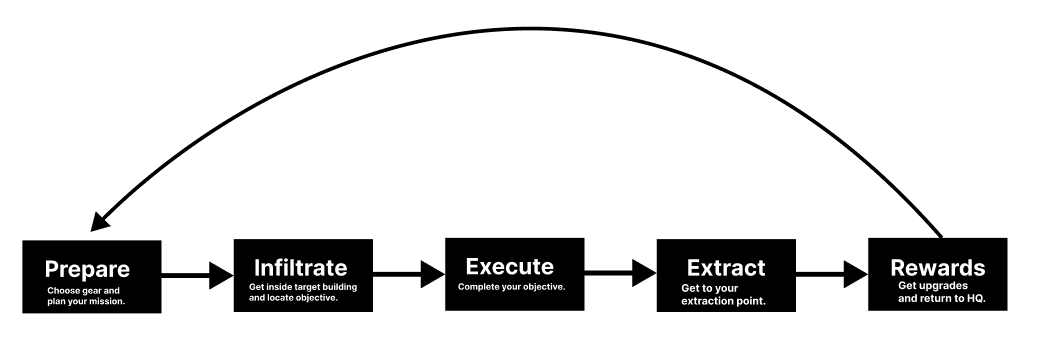
This loop is common to many tactical shooters like Ready or Not, Zero Hour, and Ground Branch. Rainbow Six Siege has a similar loop although it's a PvP game.
Hitman Freelancer is perhaps the most similar structure.
Here's a breakdown of each step:
The preparation phase is where players set the foundation for their success. Much like games such as Ready or Not, Rainbow Six Vegas, and Splinter Cell, this phase offers an opportunity to plan, strategize, and customize. However, our approach expands on this formula by introducing meaningful choices that directly impact the mission ahead.
It’s not just about picking a favorite weapon or tweaking loadouts; it’s about making critical decisions that influence how you’ll tackle the mission’s unique challenges.
Key Features
Design Goals:
We want players to feel like meticulous operatives—analyzing risks and making tough calls before even stepping into the mission. The preparation stage should create a sense of tension and excitement as players weigh their options, understanding that their decisions will ripple through the mission. Success here feels like a masterstroke of planning, while failure drives players to refine their approach.
Insertion and infiltration are where the mission begins in earnest, and the stakes immediately come into focus. Drawing inspiration from Deus Ex, Hitman, and Metal Gear Solid, this phase emphasizes both creativity and adaptability. Players will deal with responsive enemy AI and dynamic environmental challenges. Infiltration is never a fixed routine; instead, it evolves with every mission, ensuring a fresh experience each time.
Key Features:
Design Goals:
We aim to create an infiltration phase that’s unpredictable and thrilling. The player should feel like a master of improvisation, adjusting their plans in real-time based on evolving threats. Every mission should feel unique, pushing players to learn and adapt rather than falling into repetitive habits.
Design Goals
Claiming rewards should feel like a victory lap, reinforcing the player’s sense of accomplishment while motivating them to tackle the next challenge. Even in failure, players should feel like they’ve gained something meaningful, ensuring that every run contributes to their growth and mastery.
This phase focuses on the mission's core—completing the primary and optional objectives. Drawing from games like Hitman Freelancer and Splinter Cell: Chaos Theory, this stage offers open-ended scenarios where players can approach objectives using stealth, combat, or a mix of both. The environment plays a key role, offering opportunities for creativity and problem-solving.
Key Features
Design Goals:
We want the objective phase to feel like a puzzle that players can solve their way. By offering multiple paths and rewarding creativity, we ensure players feel agency over their approach while maintaining a sense of risk and excitement as they close in on their goal.
Extraction isn’t just an afterthought—it’s a crucial and high-stakes part of the mission. Similar to Escape from Tarkov and Deus Ex, reaching extraction can become a nerve-wracking race against time, enemy reinforcements, and unpredictable obstacles. Players must keep their cool to secure their rewards and escape unscathed.
Key Features
Design Goals:
The extraction phase is designed to provide an exhilarating climax to the mission. Players should feel the tension of leaving under fire or the satisfaction of a perfectly executed escape. It’s the final test of their planning, adaptability, and resourcefulness.
The mission may be over, but the rewards ensure every run feels meaningful. This phase serves as both a moment of reflection and a setup for future missions, borrowing elements from Rogue Legacy and Hitman Freelancer. Players are rewarded for their choices and performance, encouraging replayability and progression.
Key Features
Design Goals:
Rewards should feel meaningful and satisfying, ensuring every run contributes to progression. This phase serves as a victorious catharsis before the challenge continues.
Players plan their approach, infiltrate using chosen tactics, complete objectives, and extract under pressure—all while adapting to evolving enemy defenses.
Last but not least, we'll zoom out to the highest level of the game, the Campaign Loop. This is where we go beyond the random set of missions that comprise most tactical shooters and arrange the levels into a compelling narrative and addicting loop.