GAME DESIGN DOC 2.0
Game: Darkspy (working title)
STUDIO: ECHELON INTERACTIVE
Game: Darkspy (working title)
STUDIO: ECHELON INTERACTIVE

The minute-to-minute gameplay revolves around dealing with encounters. This section will outline how the player does this, before we “zoom out” further.
In essence, Darkspy combines a tactical shooter gameplay loop with a stealth loop.
This section will break down each and then look at how we bring them together.
Here is a video that summarizes the content below:
Darkspy uses the proven tactical shooter gameplay loop of:
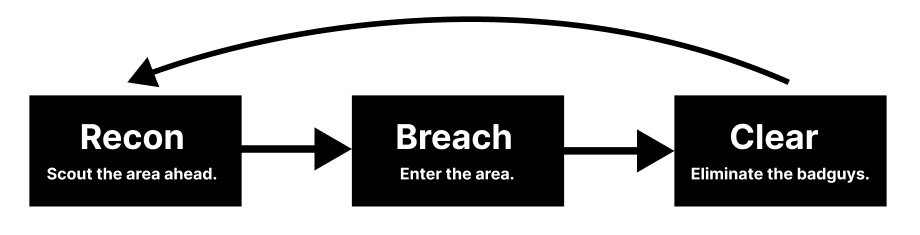
And here is a breakdown of each step:
You scout ahead to see who is the next area. Are there civilians? Enemies? Where are they standing? Where could they be hiding? How should I enter this area?
Now it's time to enter the space. This could mean simply opening the door. But most tactical shooters offer the player a variety of ways to breach, ranging from a battering ram (Ready or Not), a breaching charge (Ground Branch, Ready or Not), kicking the door (Insurgency Sandstorm, Ready or Not), rappelling through a skylight or window (Rainbow Six, Zero Hour), or even blowing a hole through a wall (Rainbow Six Siege).
Unlike a casual shooter, which usually involves bunny hopping into a room, spraying bullets, and spamming grenades like a headless chicken before hiding behind a wall to regenerate your health, tactical shooters require careful consideration of angles.
VIDEO: In this video I explain how rooms in tactical shooters must be designed to facilitate the tense tactical gameplay that we want to support.
VIDEO: And here we can see these concepts in action in Ready or Not.
Darkspy features a robust tactical shooter that rivals (and in some ways goes beyond) its competitors. We believe that having this level of intense, tactical gameplay in our fresh setting (instead of the "usual suspects": Iraq, Afghanistan, and Russia) will differentiate Darkspy from the competition and make a compelling experience.
Unlike typical tactical shooters, however, Darkspy also uses a stealth gameplay loop:
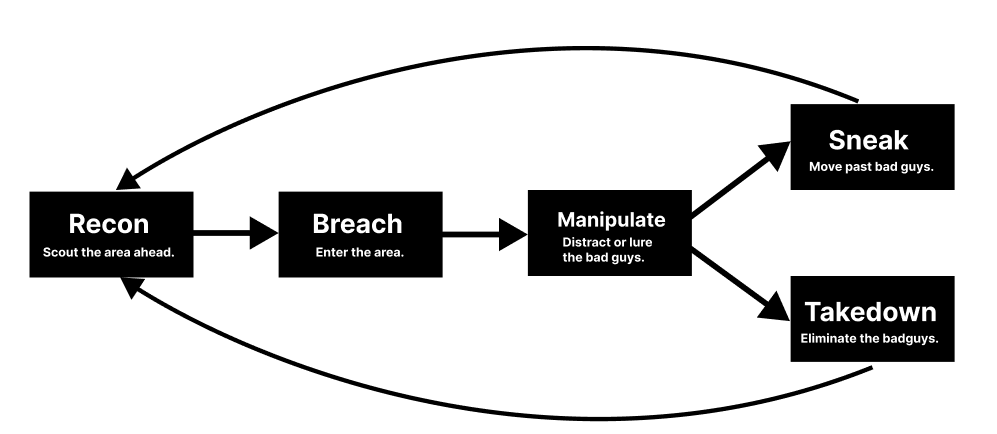
And here's a breakdown of each step:
Stealth games also allow the player to scout ahead, but with different tactics.
Like tactical shooters, stealth games require the player to enter the space. But whereas tactical shooters usually do this aggressively and loudly, the stealth gameplay loop calls for a more quiet entry which may involve lockpicking or rappelling.
This is where the stealth gameplay loop differs considerably from the tactical shooter gameplay loop. Unlike the tactical shooter loop, where the goal is to kill everyone, the stealth gameplay loop usually requires the player to "manipulate" the enemy.
By manipulate, I mean cause some sort of distraction and confusion. This could be turning off the lights, making a noise, throwing an object, etc.
If the player is taking a "ghost" approach (trying to remain totally undetected), then they will use the manipulation to sneak past enemies. Usually this means moving slowly as the enemy goes to investigate a disturbance, while staying in shadows.
If the player is using a more aggressive stealth style (usually called "panther"), they can use the distraction they created to lure enemies out of each other's line of sight.
This allows the player to eliminate enemies with takedowns.
Darkspy combines these two gameplay loops into one.
In a general sense, this is nothing new.
Games commonly combine a combat gameplay loop and stealth gameplay loop to give players more options (see Splinter Cell, Deus Ex, Ghost Recon, Deathloop, Dishonored, Assassin's Creed, Far Cry, Sniper Ghost Warrior Contracts, Watch Dogs).
But it has never been done in a tactical shooter.
Rather than complexifying tactical shooters even more by adding even more weapon customization (how can we go beyond what Ground Branch and Escape from Tarkov already do?) which would only make the game more sweaty and niche, we believe that adding stealth elements like takedowns, more gadgets, and lights/shadows is an innovation waiting to happen that significantly broadens the appeal of the genre.
Pure stealth games have struggled because they're often too challenging and players get bored or frustrated. This leads to developers either committing to "stealth only" which limits the appeal... or, forces developers to add combat which often makes the game far too easy. If you can just kill everything, then why bother sneaking?
We believe that tactical shooters and stealth games are a match made in heaven.
When we put these two loops together, we get this:
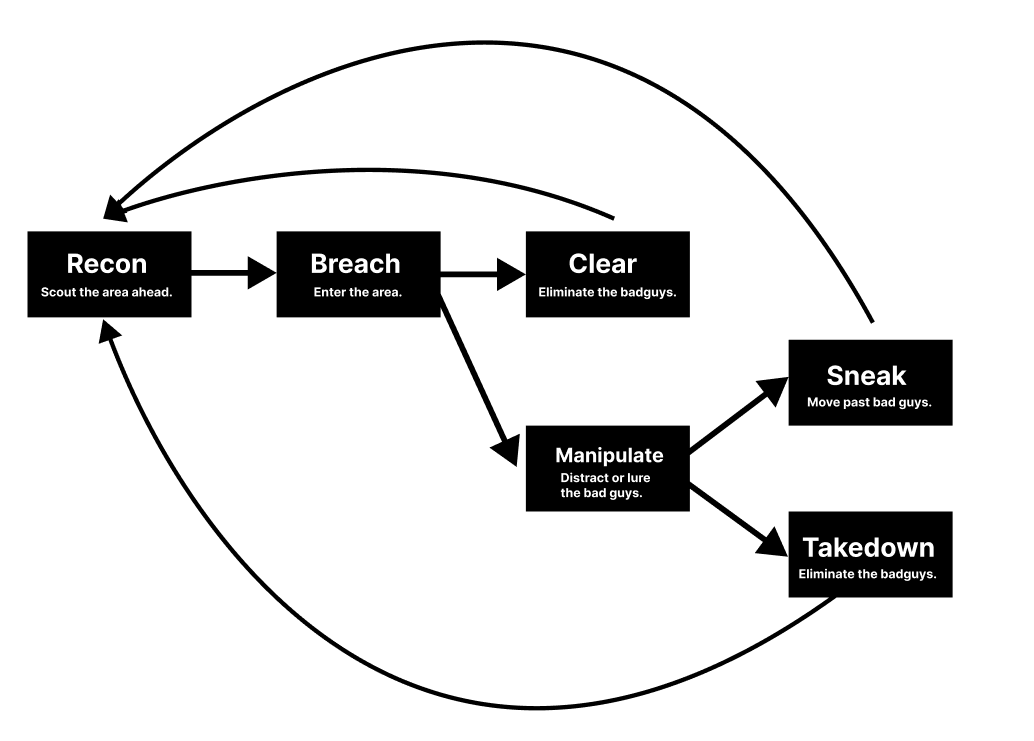
VIDEO: In this video, I demonstrate how a room can facilitate both combat and stealth gameplay styles. This is an early prototype made in Unreal Engine 1.
Now, I'm going to end this section here and move onto the mission gameplay loop which is a higher order look at the process for executing missions.
However, you don't know what specific features we're including.
The specific features of Darkspy are covered in a separate document that goes into (what some would call) excruciating detail and divided features up by priority.
Darkspy’s encounters reward tactical thinking, stealth, and adaptability. Every mission is a puzzle where players must assess, manipulate, and execute with precision using a mix of realistic weapons, near-future tools, and environmental tactics.